If you follow tech news, you see two terms everywhere: Generative AI (Gen AI) and AI agents. They are related, but they are not the same thing, and the difference matters when you are deciding what to learn next.
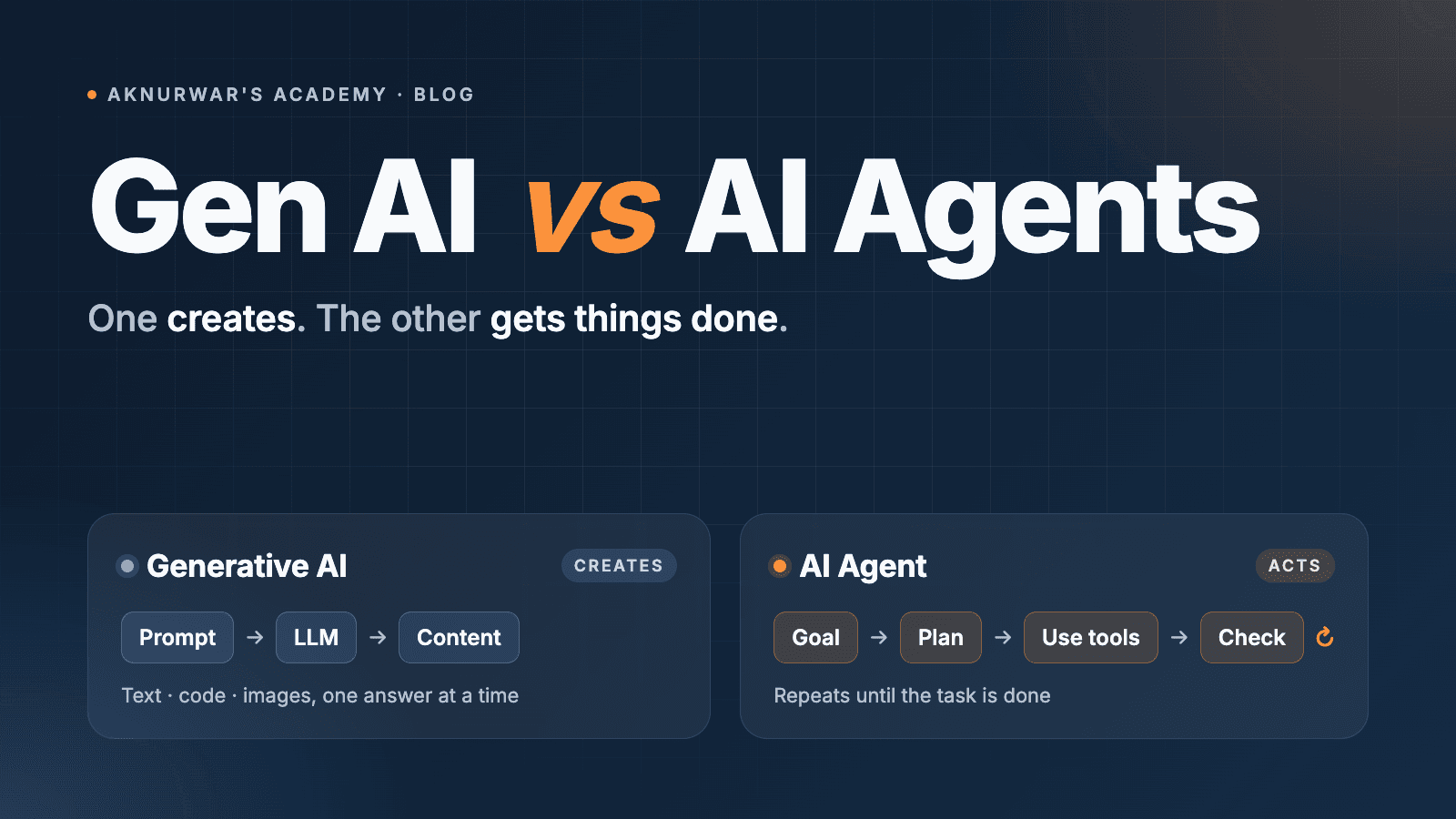
In one line: Generative AI creates: you ask, it answers. An AI agent acts: you give it a goal, and it works step by step until the job is done. Most AI agents use generative AI as their "brain".
What is Generative AI?
Generative AI is a type of artificial intelligence that creates new content: text, code, images, audio, or video. It learns patterns from huge amounts of existing data and uses them to produce something new when you ask.
The best-known examples are large language models (LLMs), such as the models behind ChatGPT, Claude, Gemini, and Llama. Image tools such as Midjourney and Stable Diffusion are generative AI too.
How it works, simply
- You write a prompt, for example: "Explain recursion with a real-life example."
- The model reads it and predicts the most likely response, one small piece (a token) at a time.
- You get one answer. If you want more, you ask again.
What Gen AI is good at
- Writing and rewriting: emails, summaries, résumés, and social media posts
- Explaining concepts and answering questions
- Writing code and explaining code
- Translating between languages
- Creating images and designs from a description
Where it falls short
- It doesn't act on its own. It can write an email, but it cannot send it unless someone connects it to an email tool.
- It can be confidently wrong. LLMs sometimes "hallucinate": they produce facts, numbers, or links that look right but are not.
- Its knowledge has a cut-off date. Without search or access to your documents, it only knows what was in its training data.
- It waits for you. Every step needs a new prompt from you.
What is an AI agent?
An AI agent is a system that uses a language model to reach a goal by itself, over many steps. Instead of answering once, it plans what to do, uses tools, looks at the results, and decides the next step. It repeats this until the task is done, or until it needs your input.
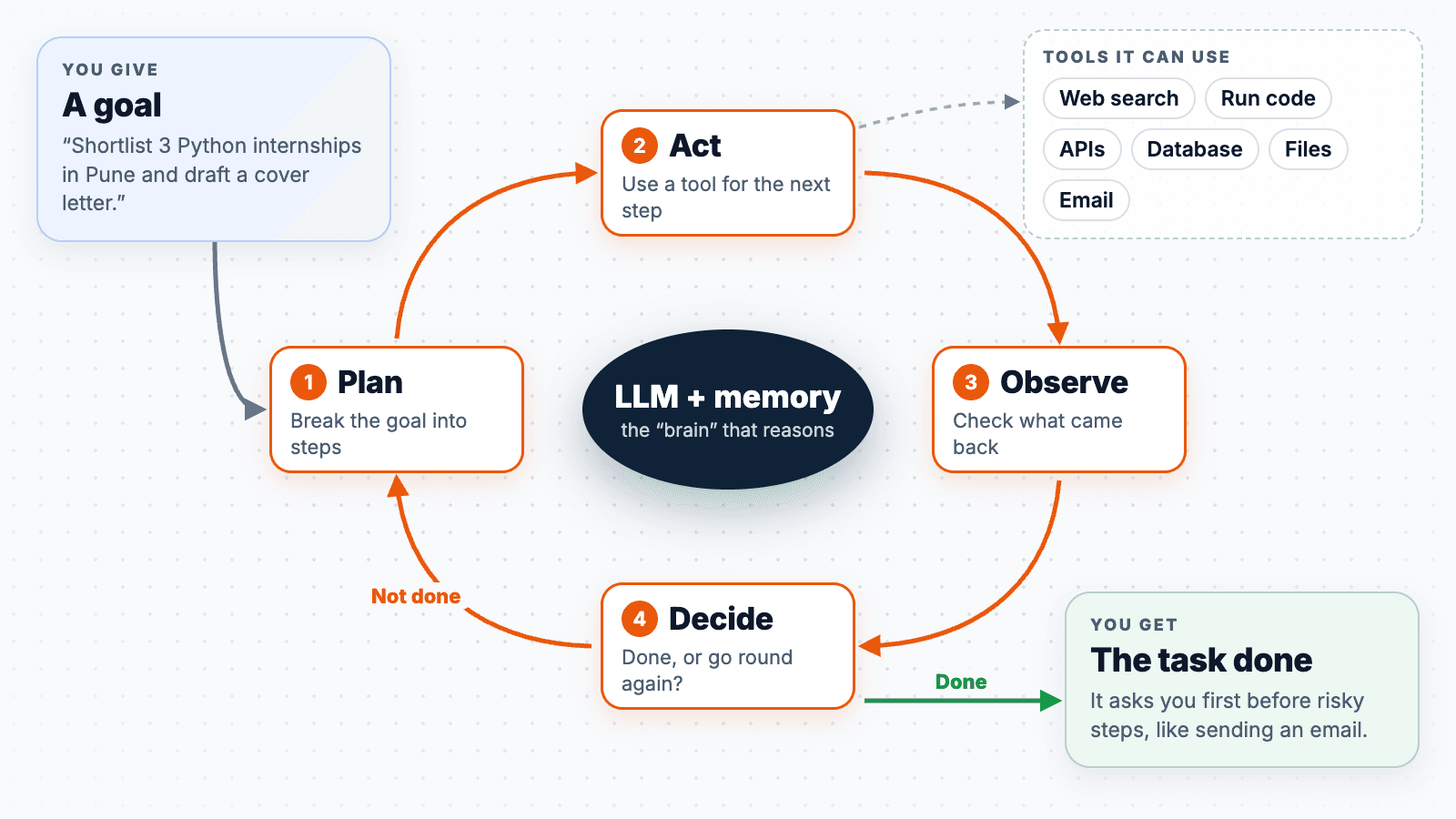 The agent loop: plan, act, observe, decide, and repeat until the task is done
An agent usually has five parts:
| Part | What it does |
|---|---|
| Model (LLM) | The "brain" that reads, reasons, and decides the next step |
| Instructions and goal | What the agent should achieve, and the rules it must follow |
| Tools | Abilities to act: web search, running code, calling APIs, reading files, querying a database, sending email |
| Memory | Notes about the task so far, and sometimes lessons from past tasks |
| Loop and guardrails | Repeats plan, act, observe, decide, with limits on cost, time, and risky actions |
An example you can picture
Say you type: "Find three Python internships in Pune posted this week, compare them, and draft a cover letter for the best one."
- A Gen AI chatbot without tools gives you general tips for finding internships and a template cover letter. Useful, but you still do the work.
- An AI agent searches job sites, opens each posting, compares stipend, skills, and location in a table, picks the best match for your résumé, and drafts a tailored cover letter. A well-built agent then asks you before applying on your behalf.
The model underneath can be the same. The difference is the tools, the loop, and the freedom to take many steps.
Gen AI vs AI agents: side by side
| Generative AI | AI agent | |
|---|---|---|
| Main job | Creates content | Completes tasks |
| You give it | A prompt | A goal |
| Steps | Usually one response | Many steps in a loop |
| Tools | None by default | Search, code, APIs, files, apps |
| Who drives | You, prompt by prompt | The agent, within limits you set |
| Memory | Mostly the current chat | Tracks the task, and can remember across tasks |
| Main risk | Wrong or made-up answers | Wrong actions, so it needs permissions and checks |
| Example | "Write a product description" | "Research three competitors, update the sheet, and draft the report" |
It's not either/or: agents are built on Gen AI
Think of it as a ladder. Each step adds more independence:
- Chatbot: an LLM answering your prompts.
- RAG (retrieval-augmented generation): the LLM also searches your documents, such as a syllabus, company policies, or product manuals, so its answers are based on real data.
- Workflow: an LLM inside fixed steps that a developer designed, for example "read the support ticket, classify it, draft a reply".
- Agent: the LLM chooses the steps and the tools itself, loops until done, and asks a person when it is unsure.
When people say "agentic AI", they mean systems near the top of this ladder. Every agent still depends on a generative model at its core, so time spent learning Gen AI is never wasted.
Where you'll see AI agents at work
- Software development: coding agents such as Claude Code, GitHub Copilot's coding agent, and Cursor can read a codebase, write changes, run the tests, and fix what fails, with a developer reviewing the result.
- Customer support: an agent checks an order's status, explains a delay, and starts a refund within limits the company sets, passing tricky cases to a person.
- Data and reports: an agent pulls numbers from a database, builds charts, and writes a weekly summary.
- Research: an agent reads many web pages or papers and gives you a summary with sources.
- Office work: scheduling meetings, filling in forms, and keeping spreadsheets up to date.
The honest limits of AI agents
Agents are powerful, but they are not magic:
- More steps mean more chances to go wrong. A small mistake early in the loop can grow by the end.
- They can be tricked. A web page or email can hide instructions meant to mislead an agent. This is called prompt injection. Well-built agents treat what they read as information, not as orders.
- Cost and speed. Many model calls cost more and take longer than a single answer.
- Permissions matter. An agent should get only the access it needs, and should ask a person before anything hard to undo, such as paying, deleting, or sending messages.
That is why companies need people who can build, test, and supervise agents, not just use them.
What should you learn first?
If you are a student or a fresher, here is a practical order:
- Python and APIs. Learn Python well, from variables to classes, and practise reading JSON and calling web APIs. Most Gen AI and agent tools are used from Python or JavaScript.
- LLM basics. Prompts, tokens, context windows, and temperature. Call an LLM from your own code, not only from a chat window.
- RAG. Embeddings, splitting documents into chunks, and vector databases such as pgvector, Chroma, or Pinecone. Many real company projects start here.
- Agents. Tool calling (also called function calling), then a framework such as LangGraph, CrewAI, the OpenAI Agents SDK, or the Claude Agent SDK. Also learn the Model Context Protocol (MCP), an open standard for connecting AI apps to tools and data.
- Shipping it. Testing and evaluating AI output, adding guardrails, and deploying with FastAPI, Docker, and a cloud platform such as AWS or Azure.
Three projects to build and show in interviews
- Gen AI: a notes summariser that turns long lecture notes into key points and quiz questions.
- RAG: "chat with your syllabus": upload PDFs and get answers that show the page they came from.
- Agent: a job-search assistant that searches postings, shortlists matches for your résumé, drafts cover letters, and waits for your approval before anything is sent.
Tip: Interviewers care less about which framework you used and more about whether you can explain your design: why the agent needs each tool, how you stop it from looping forever, and how you check its answers.
Frequently asked questions
Is ChatGPT an AI agent?
ChatGPT started as a generative AI chatbot. Newer modes that can browse the web, run code, and take actions in a browser make it behave more like an agent. What matters is what it can do, not the product name.
Do I need machine learning maths to build AI agents?
Not to get started. Building applications with LLMs depends mostly on programming, APIs, and good design. Maths and machine learning theory help if you later want to train or fine-tune models yourself.
Will AI agents replace software engineers?
They are changing the work. Agents can write and fix a lot of code, but someone still has to decide what to build, design the system, review the output, and take responsibility for it. Engineers who know how to work with agents are in a stronger position.
Gen AI or AI agents: which should I learn first?
Gen AI first. Agents are built on top of it, so understanding prompts, LLM APIs, and RAG makes agents much easier to learn.
Learn Gen AI and AI agents with us
At Aknurwars Academy, our trainers teach Python, Gen AI, RAG, and agentic AI with hands-on projects. In our job-oriented programs, interns build features for real products at Xbreyins India Pvt Ltd and work the way real software teams do.
- Explore our IT courses
- See the job-oriented programs
- Have a question? Talk to our team